
“How many mock tests should I attempt before CAT 2026?”
One of the most common questions every CAT aspirant asks .
Some students believe attempting as many mocks as possible is the key to success, while others keep postponing mocks because they don’t feel “fully prepared.”
The reality is that neither approach works.
A well-planned CAT mock strategy is one of the biggest factors that separates a good percentile from an exceptional one. Mock tests not only assess your preparation but also train your mind to perform under pressure.
At Presto Solutions, we’ve mentored thousands of CAT aspirants over the years, and one thing has remained constant—students who consistently analyse their mock tests perform significantly better than those who simply attempt more tests.
So, let’s understand how many mocks you should give before CAT 2026 and how to plan them effectively.

Why Are CAT Mock Tests So Important?
Mock tests are much more than practice papers.
They are the closest simulation of the actual CAT examination and help you prepare for the challenges you’ll face on exam day.
A good mock test helps you:
- Understand the latest CAT exam pattern.
- Improve speed and accuracy.
- Build exam-day stamina.
- Learn effective time management.
- Identify your strengths and weaknesses.
- Develop your own attempt strategy.
- Build confidence before the actual exam.
Think of every mock as a rehearsal. The more meaningful rehearsals you have, the more confident you’ll be on the final day.
If you’re just starting your preparation, read our complete guide on CAT 2026 Preparation Strategy.
So, How Many Mocks Should You Give Before CAT 2026?
There isn’t one fixed number that suits everyone.
Your preparation level, available time, and consistency all play a role.
However, based on years of mentoring successful CAT aspirants, Presto Solutions recommends attempting around 35–40 full-length mocks before CAT 2026.
This number provides enough exposure to:
- Different levels of difficulty
- Various question patterns
- Multiple test-taking strategies
- Real exam pressure
Remember:
Attempting 40 mocks without analysing them is far less effective than attempting 25 mocks with proper analysis.
Quality will always be more important than quantity.
CAT Mock Schedule: Month-Wise Complete Plan
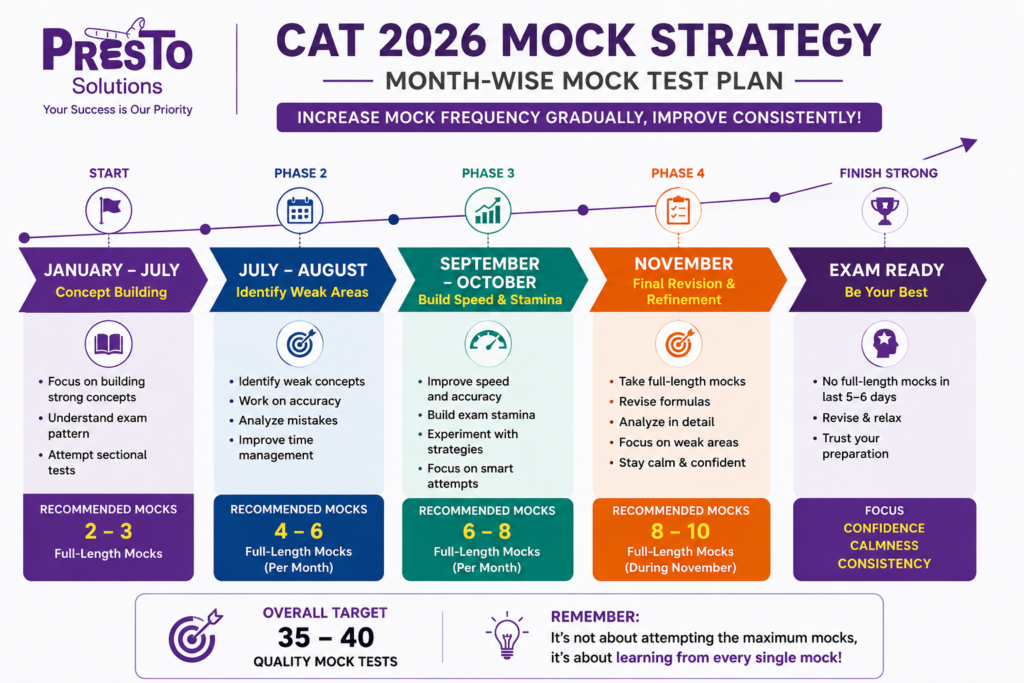
The best way to prepare is to increase your mock frequency gradually as your preparation progresses.
January – July: Focus on Building Concepts
The initial months of preparation should primarily be dedicated to building strong concepts.
Spend most of your time strengthening:
- Quantitative Aptitude
- Logical Reasoning & Data Interpretation
- Verbal Ability & Reading Comprehension
Recommended Plan
- Attempt 2–3 full-length mocks.
- Focus more on concept-building than scores.
- Regularly attempt sectional tests.
July – August: Identify Weak Areas
By now, most of your syllabus should be nearing completion.
This is the ideal time to increase your mock frequency.
Your focus should shift towards identifying:
- Weak concepts
- Time-consuming question types
- Sectional mistakes
- Accuracy issues
Recommended Plan
Attempt:
4–6 full-length mocks every month
or
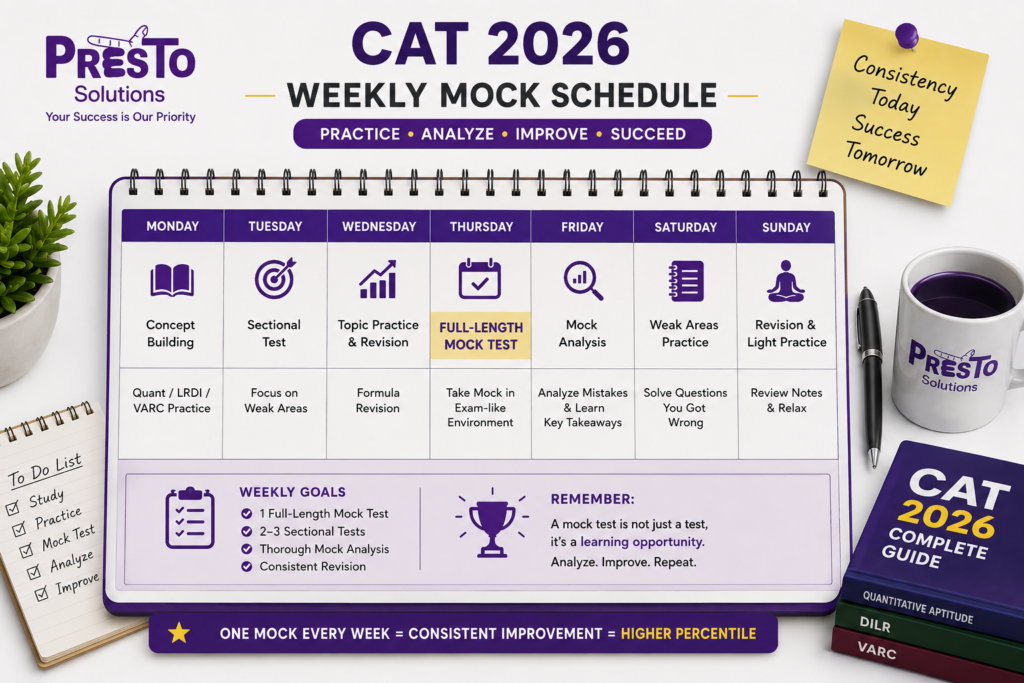
One mock every week.
Spend several hours analysing every mock.
September – October: Build Speed and Stamina
Once your syllabus is completed, your preparation enters its most important phase.
Focus on:
- Speed
- Accuracy
- Stamina
- Smart question selection
- Time management
Attempt:
6–8 mocks every month
or
1–2 mocks every week.
Experiment with different strategies and finalise one before November.
November: Give the Final Finishing Touch
The last month before CAT is all about refinement.
Focus on:
- Revision
- Mock Tests
- Formula Sheets
- Mistake Notebook
- Previous Mock Analysis
Attempt
8–10 mocks
during November.
Avoid full-length mocks during the final 5–6 days before CAT.

Suggested CAT Mock Schedule at a Glance
| Preparation Phase | Focus Area | Recommended Mock Frequency | Objective |
| January – July | Concept Building | 2–3 Full-Length Mocks (Total) | Understand the CAT pattern, build concepts, and identify strengths & weaknesses. |
| July – August | Identify Weak Areas | 4–6 Full-Length Mocks per Month (≈ 1 Mock Every Week) | Improve accuracy, identify weak topics, and develop a test-taking strategy. |
| September – October | Speed & Stamina | 6–8 Full-Length Mocks per Month (1–2 Mocks Every Week) | Build speed, stamina, and optimize time management. |
| November | Final Revision | 8–10 Full-Length Mocks (Stop 5–6 Days Before CAT) | Fine-tune your strategy, revise, and build confidence for exam day. |
Overall Recommendation: Aim to attempt 35–40 quality full-length mock tests before CAT 2026. Remember, every mock should be followed by 2–3 hours of detailed analysis for maximum improvement.
You can always verify the latest CAT exam schedule and notifications on the official CAT website.
Official CAT Website: https://iimcat.ac.in
Don’t Just Attempt Mocks—Analyse Them
One of the biggest mistakes students make is treating mock tests as just another exam.
In reality, the learning begins after the mock ends.
Every mock should answer questions like:
- Why did I get this question wrong?
- Was it a conceptual mistake or a silly error?
- Did I spend too much time on one question?
- Should I have skipped certain questions?
- Which section affected my overall percentile?
- What can I improve before the next mock?
Ideally, you should spend 2–3 hours analysing every full-length mock.
This habit alone can improve your percentile dramatically over time.
How to Analyse CAT Mock Tests Effectively:

Common Mistakes Students Make During Mock Preparation
1. Attempting Too Many Mocks Too Early
Without strong concepts, frequent mocks often lead to poor scores and unnecessary frustration.
Build your foundation first.
2. Ignoring Sectional Tests
Many students only focus on full-length mocks.
Sectional tests are equally important because they help improve specific sections like VARC, DILR, or QA.
3. Chasing Scores Instead of Learning
Don’t judge your preparation based on one mock.
Instead, look for gradual improvement in accuracy, speed, and decision-making.
4. Giving Mocks in a Distracting Environment
Avoid attempting mocks:
- While checking your phone
- In noisy surroundings
- With frequent breaks
Create an exam-like environment every time you take a mock.
5. Changing Strategy After Every Mock
One poor score does not mean your preparation strategy is wrong.
Stay consistent.
Make small improvements after every analysis instead of completely changing your approach.
Presto Solutions’ Recommended CAT Practice Strategy
At Presto Solutions, we encourage every student to follow a balanced and disciplined approach.
Our recommendation is simple:
- ✅ Build concepts first.
- ✅ Increase mock frequency gradually.
- ✅ Analyse every mock thoroughly.
- ✅ Maintain a mistake notebook.
- ✅ Practice sectional tests regularly.
- ✅ Revise weak areas consistently.
- ✅ Focus on continuous improvement rather than chasing scores.
This structured approach has helped hundreds of students secure admissions into top B-schools, including IIMs, FMS, SPJIMR, MDI, IITs, IMT, TAPMI, and other leading management institutes.
Looking for the best books? Check our Best Books for CAT 2026 Preparation guide.
Final Thoughts
Cracking CAT isn’t about attempting the highest number of mock tests.
It’s about learning something valuable from every single mock you attempt.
A smart CAT mock strategy, a consistent CAT mock schedule, and detailed mock analysis will help you improve steadily and confidently.
Aim for 35–40 quality mock tests, analyse each one carefully, and keep refining your strategy.
Remember,
Every mock is an opportunity to make mistakes today so that you don’t repeat them on CAT exam day.
Useful Resources
Official CAT Website
AICTE Official Website
Ministry of Education
Prepare Smarter with Presto Solutions
At Presto Solutions, we believe that mock tests should do more than just generate a score—they should help you become a better test-taker.
Our comprehensive CAT Test Series includes:
- Full-length CAT pattern mocks
- Sectional tests
- Detailed performance analysis
- One-on-one mentor feedback
- Personalized improvement plans
- Strategy sessions based on your mock performance
Whether you’re targeting your first CAT attempt or aiming for a 99+ percentile, our mentors will help you prepare with confidence and clarity.
Ready to crack CAT 2026?
Join Presto Solutions and build a winning CAT preparation strategy with expert guidance, proven study plans, and the right mock test approach.
📍 Presto Solutions – Central India’s Trusted Management Entrance Coaching Institute
Courses Offered: CAT | XAT | NMAT | SNAP | CMAT | IPMAT | CUET
📞 Book a free counselling session today and take the first step toward your dream B-school.
Frequently Asked Questions (FAQs)
1. How many mock tests should I attempt before CAT 2026?
There is no fixed number that works for every student. However, experts at Presto Solutions recommend attempting 35–40 quality full-length mock tests before CAT 2026. More importantly, every mock should be followed by detailed analysis to identify mistakes and improve performance.
2. When should I start taking CAT mock tests?
You should start taking mock tests after building your basic concepts. During the January–July phase, attempt 2–3 full-length mocks to understand the exam pattern. As your preparation progresses, gradually increase the frequency of mock tests.
3. Is attempting more mock tests always better?
No. Attempting more mock tests without analysing them will not improve your score. It is better to attempt fewer mocks and spend 2–3 hours analysing each one than to rush through multiple tests without learning from your mistakes.
4. How much time should I spend analysing a CAT mock test?
Ideally, you should spend 2–3 hours analysing every full-length mock test. Review your incorrect answers, skipped questions, time management, accuracy, and overall strategy before attempting the next mock.
5. Should I take sectional tests along with full-length mocks?
Yes. While full-length mock tests help build stamina and exam strategy, sectional tests are equally important for improving specific sections like VARC, DILR, and Quantitative Aptitude. A balanced preparation plan should include both.
6. Should I give mock tests during the last week before CAT?
It is advisable to avoid full-length mock tests during the final 5–6 days before CAT. Instead, focus on revision, formula sheets, mistake notebooks, light practice, and maintaining a healthy sleep schedule to stay mentally fresh for exam day.
7. What is the ideal CAT mock schedule?
A balanced CAT mock schedule is:
- January–July: 2–3 full-length mocks
- July–August: 4–6 mocks per month
- September–October: 6–8 mocks per month
- November: 8–10 mocks (stop 5–6 days before CAT)
This gradual increase helps build confidence, speed, and exam temperament.
8. Which CAT mock test series should I join?
Choose a mock test series that closely follows the latest CAT pattern, provides detailed performance analysis, percentile comparison, and expert feedback. At Presto Solutions, our CAT Test Series includes full-length mocks, sectional tests, one-on-one mentor guidance, and personalized performance analysis to help students maximize their CAT score.