Government vs Private MBA Colleges: Which MBA Should You Choose?
Choosing an MBA college is one of the most important career decisions you’ll make. While many students focus only on rankings or placement packages, the real decision is much more complex.
Every year, thousands of MBA aspirants ask the same question:
Should I choose a Government MBA College, an IIM, or a Private B-School?
The answer isn’t the same for everyone.
A Government MBA college may offer excellent return on investment with affordable tuition fees. An IIM can provide unmatched brand value, leadership opportunities, and world-class placements. On the other hand, a reputed private B-School may offer modern infrastructure, specialized MBA programs, and stronger corporate exposure.
Instead of asking “Which is better?”, you should ask “Which is better for my career goals?”
This guide compares Government MBA Colleges, IIMs, and Private B-Schools across every important parameter—including fees, placements, faculty, infrastructure, alumni network, industry exposure, and ROI—so that you can make an informed decision.
If you’re still planning your MBA journey, understanding the entrance exams accepted by different colleges should be your first step. Before shortlisting institutes, read our guide on MBA Entrance Exams in India.

Why Your MBA College Choice Matters
An MBA is not just another postgraduate degree—it’s a long-term investment in your career.
The institute you choose influences:
- The quality of education you receive
- Your internship opportunities
- Your professional network
- Your placement opportunities
- Your starting salary
- Your long-term career growth
Many students make the mistake of selecting a college based only on advertisements or the highest placement package. However, factors such as faculty quality, curriculum, accreditation, alumni network, and return on investment often have a much greater impact on your career than a single placement statistic.
For example, a college charging ₹25 lakh in fees with an average placement of ₹14 lakh may not necessarily be a better choice than a government institute charging ₹3 lakh with an average package of ₹12 lakh. Looking beyond the headline numbers helps you make a smarter financial and career decision.
Government MBA Colleges (Non-IIMs)
Government MBA colleges have consistently remained one of the most preferred choices for management aspirants across India. Their biggest strength lies in offering quality education at a comparatively affordable cost.
Unlike most private institutes, government colleges receive financial support from the government, allowing them to keep tuition fees lower while maintaining strong academic standards.
Some of India’s most respected Government MBA institutions include:
- Faculty of Management Studies (FMS), Delhi
- Jamnalal Bajaj Institute of Management Studies (JBIMS), Mumbai
- Department of Management Studies (DMS), IIT Delhi
- Delhi School of Economics
- TISS Mumbai (Management Programs)
These institutes have built strong reputations over decades and continue to produce successful managers working across consulting, banking, FMCG, manufacturing, technology, and the public sector.
Why Students Prefer Government MBA Colleges
1. Affordable Tuition Fees
One of the biggest advantages of Government MBA colleges is affordability.
Compared to many private B-Schools that charge ₹15–25 lakh for an MBA program, several government institutions offer management education at a fraction of that cost.
Lower fees reduce the financial burden on students and minimize dependence on education loans.
2. Excellent Return on Investment (ROI)
ROI is one of the strongest reasons students choose government MBA colleges.
A lower investment combined with competitive placement opportunities often results in significantly better financial returns.
For example:
- MBA Cost: ₹2–5 lakh
- Average Placement: ₹10–18 lakh per annum
This creates a much shorter payback period compared to many expensive private institutes.
3. Experienced Faculty
Government institutions usually have highly qualified faculty members with years of teaching, research, and industry consulting experience.
Instead of focusing only on practical skills, these institutes emphasize conceptual clarity, analytical thinking, and problem-solving—qualities that remain valuable throughout a management career.
4. Strong Academic Environment
Government MBA colleges are known for their academic discipline.
Students are exposed to:
- Case studies
- Research projects
- Group discussions
- Business simulations
- Presentations
- Industry assignments
This academic rigor prepares students for leadership roles in the corporate world.
5. Established Alumni Network
Most reputed government MBA colleges have alumni working in top organizations across India and abroad.
A strong alumni network can significantly improve:
- Internship opportunities
- Industry networking
- Mentorship
- Placement support
- Career transitions
Challenges of Government MBA Colleges
Despite their advantages, Government MBA colleges are not the perfect choice for every student.
Some common challenges include:
Highly Competitive Admissions
Most reputed government institutes admit students through competitive entrance exams such as CAT, XAT, or CMAT.
A high percentile is usually required to secure admission.
Infrastructure May Vary
Although several government institutes have excellent campuses, infrastructure standards can vary significantly from one college to another.
Students should evaluate facilities instead of assuming that every government institute offers similar resources.
Industry Exposure Differs
Corporate interaction, international collaborations, startup incubation, and global immersion programs differ considerably across institutions.
Therefore, comparing colleges individually is always a better approach than judging them solely based on ownership.
Who Should Choose a Government MBA College?
Government MBA colleges are ideal for students who:
- Want affordable education
- Prioritize ROI over luxury infrastructure
- Have strong entrance exam scores
- Prefer academic excellence
- Plan to build long-term management careers

Indian Institutes of Management (IIMs)
When discussing MBA education in India, the conversation is incomplete without the Indian Institutes of Management (IIMs).
Recognized globally for academic excellence, leadership development, and exceptional placement records, IIMs have become the benchmark for management education in the country.
Every year, thousands of students compete for a limited number of seats, making admission to an IIM one of the most competitive achievements for an MBA aspirant.
Leading companies such as McKinsey & Company, Boston Consulting Group (BCG), Bain & Company, Deloitte, Accenture Strategy, Amazon, Microsoft, Goldman Sachs, Tata Group, and Aditya Birla Group regularly recruit from top IIM campuses.
According to the latest National Institutional Ranking Framework (NIRF) rankings, several IIMs consistently feature among India’s top management institutes.
NIRF Management Rankings
Similarly, students should always verify admission criteria, eligibility, and program details from the official websites of the respective IIMs.
Indian Institute of Management Ahmedabad:
Why IIMs Are Considered the Gold Standard
The reputation of an IIM goes far beyond its placement statistics. These institutes combine academic excellence, experienced faculty, global collaborations, cutting-edge research, and one of the strongest alumni networks in the business world.
Some of the biggest advantages include:
- Exceptional brand value
- World-class faculty
- Outstanding placement opportunities
- International exposure
- Strong alumni network
- Leadership-focused curriculum
- Global corporate recognition
However, admission requires excellent performance in the CAT exam, followed by a rigorous selection process involving academics, work experience (where applicable), and personal interviews.

Private B-Schools: Are They Worth the Investment?
Private B-Schools have evolved significantly over the past decade. Gone are the days when students considered them only as an alternative after government colleges. Today, several reputed private management institutes compete with top government institutions by offering industry-oriented curricula, modern infrastructure, global collaborations, and specialized MBA programs.
Unlike many traditional colleges, private B-Schools focus heavily on practical learning. Students participate in live projects, internships, industry certifications, business simulations, startup incubation programs, and corporate mentoring, ensuring they graduate with skills that employers actively seek.
However, not every private MBA college offers the same quality. While some institutions deliver outstanding placements and excellent industry exposure, others may struggle to provide satisfactory career outcomes. Therefore, careful research is essential before making your decision.
Before applying to any private MBA college, ensure that it is approved by the All India Council for Technical Education (AICTE) and recognized by the University Grants Commission (UGC).
AICTE Approved Institutes
URL: https://www.aicte-india.org
University Grants Commission (UGC)

Why Students Choose Private B-Schools
Private MBA colleges continue to attract thousands of aspirants because they often provide a learning experience that closely matches current industry expectations.
1. Modern Infrastructure
Most leading private B-Schools invest heavily in world-class campuses, digital classrooms, innovation labs, libraries, co-working spaces, and technology-enabled learning.
Such facilities create an engaging learning environment and encourage collaboration among students.
2. Industry-Oriented Curriculum
Private institutes frequently update their curriculum to match changing business trends.
Students gain exposure to emerging fields such as:
- Business Analytics
- Digital Marketing
- Product Management
- FinTech
- Data Science
- Artificial Intelligence in Business
- Supply Chain Analytics
- Entrepreneurship
This helps graduates remain relevant in today’s competitive job market.
3. Strong Corporate Exposure
One of the biggest advantages of reputed private B-Schools is their close relationship with industry.
Students regularly participate in:
- Guest lectures by CXOs
- Industry visits
- Corporate competitions
- Live consulting projects
- Summer internships
- Leadership conclaves
These experiences bridge the gap between classroom learning and real business challenges.
4. Multiple Admission Opportunities
Unlike IIMs that primarily rely on CAT, many private B-Schools accept multiple entrance exams such as:
- CAT
- XAT
- CMAT
- MAT
- NMAT
- SNAP
This gives students greater flexibility during the admission process.
5. Global Exposure
Many reputed private institutions have collaborations with international universities, allowing students to participate in exchange programs, international immersion trips, and dual-degree opportunities.
Such exposure helps students understand global business practices and multicultural work environments.
Challenges of Private B-Schools
Although private B-Schools offer several advantages, students should also be aware of the potential challenges.
Higher Tuition Fees
Private MBA programs generally cost significantly more than government colleges.
Depending on the institute, the total program cost may range from ₹10 lakh to ₹30 lakh or even higher.
Therefore, students should carefully evaluate whether the expected salary justifies the investment.
ROI Varies Significantly
Unlike top government colleges and IIMs, ROI among private B-Schools differs considerably.
Some institutes provide excellent placement outcomes, while others may not deliver sufficient returns on investment.
Always compare:
- Average salary
- Median salary
- Placement percentage
- Recruiters
- Program fees
instead of relying only on the highest salary package advertised.
Placement Quality Differs
A common mistake students make is assuming that every private MBA college offers similar placement opportunities.
In reality, recruiter quality, average salary, internship support, and alumni engagement vary widely.
Before applying, review the latest placement report and, if possible, connect with alumni on LinkedIn to understand actual career outcomes.
Government MBA vs IIM vs Private B-Schools: Detailed Comparison
Choosing between these three categories becomes easier when you compare them across the factors that genuinely influence your career.
| Parameter | Government MBA Colleges | IIMs | Private B-Schools |
| Tuition Fees | Low | High | Medium to High |
| Brand Value | High | Exceptional | Depends on Institute |
| ROI | Excellent | High | Varies |
| Faculty | Experienced | World-Class | Varies |
| Placements | Good | Outstanding | Depends on Institute |
| Infrastructure | Good | Excellent | Excellent |
| Industry Exposure | Moderate | Excellent | High |
| International Exposure | Limited | Strong | Available in Top Institutes |
| Alumni Network | Strong | Global | Depends on Institute |
| Admission Difficulty | High | Very High | Moderate |
Fees Comparison
The cost of an MBA is often one of the deciding factors for students.
Here’s a general comparison:
| College Type | Approximate Fees |
| Government MBA Colleges | ₹1–5 Lakhs |
| Top IIMs | ₹20–30 Lakhs |
| Leading Private B-Schools | ₹10–25 Lakhs |
While government colleges are clearly more affordable, students should compare fees alongside placement outcomes instead of evaluating cost alone.
Placement Comparison
Placements remain one of the strongest indicators of a college’s industry reputation.
Government MBA Colleges
- Strong placements in reputed institutes
- Excellent ROI due to lower fees
- Recruiters from banking, consulting, FMCG, manufacturing, and government sectors
IIMs
- Industry-leading placement records
- Top recruiters across consulting, finance, technology, e-commerce, and leadership roles
- High average salary packages
- Global recruitment opportunities
Private B-Schools
- Excellent placements at top institutes
- Quality varies significantly across colleges
- Strong recruiter base in marketing, analytics, HR, finance, operations, and IT
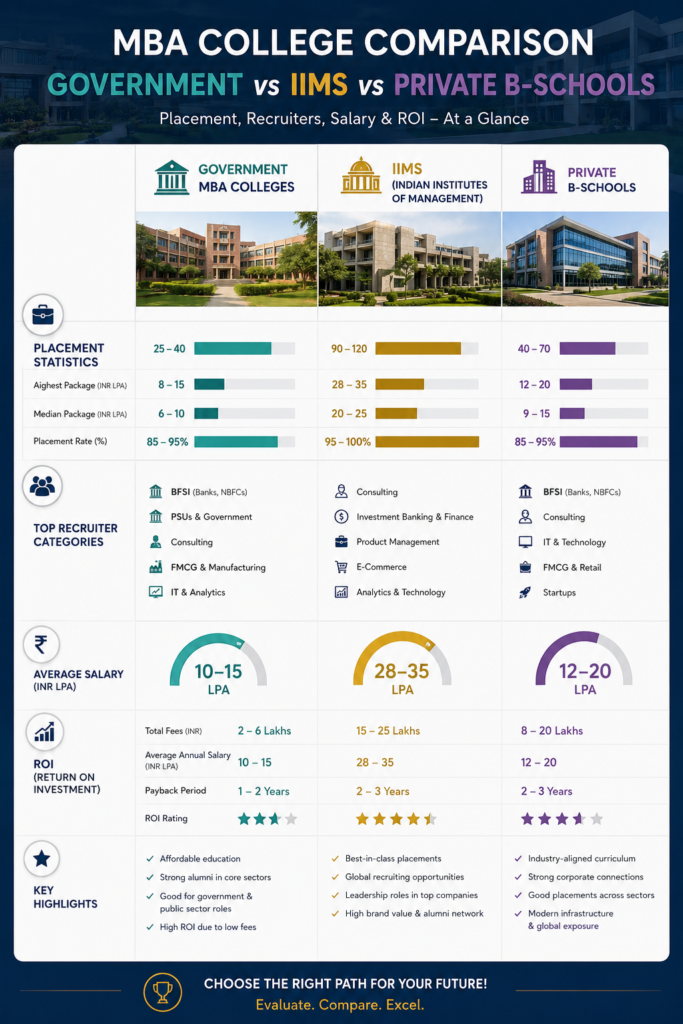
ROI Comparison
Return on Investment (ROI) is one of the most important factors while selecting an MBA college.
A college charging lower fees but offering strong placements may deliver a better financial outcome than an expensive institute with only average salary packages.
Government MBA Colleges
- ✔ Lowest investment
- ✔ Strong ROI
- ✔ Faster recovery of education costs
IIMs
- ✔ Higher investment
- ✔ Outstanding salary packages
- ✔ Excellent long-term career growth
Private B-Schools
- ✔ Moderate to high investment
- ✔ ROI depends on institute quality
- ✔ Must evaluate placements before admission
Faculty & Learning Experience
The quality of faculty directly influences your MBA experience.
Government MBA Colleges
- Strong academic orientation
- Research-focused learning
- Experienced professors
IIMs
- Globally recognized faculty
- International research collaborations
- Case-based teaching methodology
- Leadership-focused education
Private B-Schools
- Mix of academicians and industry professionals
- Practical learning approach
- Corporate mentoring programs
- Skill-based curriculum
Industry Exposure Comparison
Industry interaction is increasingly becoming one of the most important aspects of MBA education.
| Activity | Government MBA | IIM | Private B-School |
| Live Projects | Moderate | Excellent | Excellent |
| Guest Lectures | Good | Excellent | Excellent |
| Corporate Competitions | Moderate | Excellent | High |
| Summer Internships | Good | Excellent | High |
| Startup Support | Limited | Strong | Strong in Top Institutes |
Students aiming for consulting, product management, analytics, or startup careers should evaluate these opportunities carefully before making a decision.
Decision Matrix: Which Type of MBA College Fits Your Goals?
| If Your Priority Is… | Best Choice |
| Affordable MBA | Government MBA College |
| Highest ROI | Government MBA College |
| Premium Brand Value | IIM |
| Top Consulting & Finance Careers | IIM |
| Modern Infrastructure | Private B-School |
| Specialized MBA Programs | Private B-School |
| Industry Exposure | IIM / Top Private B-School |
| Flexible Admissions | Private B-School |
| Global Recognition | IIM |
Which MBA College Should You Choose?
By now, you’ve seen that there is no universal winner between Government MBA Colleges, IIMs, and Private B-Schools. Each category has its own strengths, and the right choice depends entirely on your personal goals.
Instead of following popular opinion or choosing a college based only on its brand name, evaluate each institution based on your career objectives, financial situation, academic profile, and long-term aspirations.
The following recommendations can help simplify your decision.
Choose a Government MBA College If…
Government MBA colleges are an excellent option if affordability and long-term value matter most to you.
You should consider a Government MBA college if you:
- Want a high Return on Investment (ROI).
- Prefer lower tuition fees and minimal education loans.
- Are comfortable preparing for competitive entrance exams like CAT, XAT, or CMAT.
- Value academic rigor over luxury infrastructure.
- Plan to build a stable career in consulting, banking, FMCG, manufacturing, public sector organizations, or general management.
Government MBA colleges provide excellent opportunities for students who want quality education without incurring significant financial burden.
Choose an IIM If…
An IIM is the right choice if your ambition is to work with the world’s leading organizations or pursue leadership positions.
Consider an IIM if you:
- Have a strong CAT percentile.
- Aspire to work in consulting, investment banking, strategy, or leadership roles.
- Want access to one of the strongest alumni networks in India.
- Are comfortable with an academically demanding environment.
- Want global brand recognition and long-term career growth.
Although IIMs require a substantial financial investment, they often deliver excellent long-term career outcomes through outstanding placements, leadership development, and networking opportunities.
Choose a Private B-School If…
Private B-Schools can be the right fit for students looking for flexibility and industry-oriented learning.
Choose a reputed private MBA college if you:
- Want specialized MBA programs in emerging domains.
- Prefer modern infrastructure and technology-enabled learning.
- Value practical exposure through internships, live projects, and corporate mentoring.
- Want multiple admission opportunities through CAT, XAT, CMAT, NMAT, SNAP, or MAT.
- Have shortlisted an institute with a proven placement record and recognized accreditation.
Always compare placement reports, faculty profiles, alumni outcomes, and accreditation before making your final decision.
Common Mistakes Students Make While Choosing an MBA College
Selecting the wrong MBA college can affect your career for years. Here are some common mistakes students should avoid.
1. Choosing a College Only Because of Its Brand Name
A famous college is not automatically the best choice for every student.
Instead of relying solely on reputation, compare the institute’s placements, faculty, curriculum, specializations, and ROI.
2. Looking Only at the Highest Salary Package
Many colleges advertise their highest package, but this number represents only a small percentage of students.
Instead, evaluate:
- Average salary
- Median salary
- Placement percentage
- Number of recruiters
- Internship opportunities
These indicators provide a much more realistic picture.
3. Ignoring ROI
An expensive MBA program does not necessarily guarantee better career outcomes.
Always compare the total cost of education with the average placement package and long-term growth opportunities.
4. Not Verifying Accreditation
Before applying, verify whether the institute is approved by AICTE and recognized by UGC.
These approvals play an important role in ensuring the credibility of your degree.
AICTE: https://www.aicte-india.org
5. Ignoring Alumni Network
A strong alumni network often provides valuable support through mentoring, internships, referrals, and networking opportunities.
Checking alumni profiles on LinkedIn is one of the easiest ways to understand an institute’s long-term career outcomes.
Expert Tips Before Finalising Your MBA College
Before paying the admission fee, compare every shortlisted institute using the following checklist.
- ✅ AICTE Approval
- ✅ UGC Recognition
- ✅ NIRF Ranking
- ✅ Average Placement Package
- ✅ Median Salary
- ✅ Placement Percentage
- ✅ Faculty Profile
- ✅ Industry Exposure
- ✅ Alumni Network
- ✅ Internship Opportunities
- ✅ Specializations Offered
- ✅ Total Cost of Education
- ✅ Return on Investment (ROI)
If an institute performs consistently well across these parameters, it is likely to be a reliable choice.
Build Your MBA Profile Before Applying
Admission to top MBA colleges depends on much more than just entrance exam scores.
Many leading institutes evaluate:
- Academic consistency
- Work experience
- Extracurricular achievements
- Leadership qualities
- Communication skills
- Interview performance
If you’re planning to target IIMs or other top B-Schools, start strengthening your profile as early as possible.
For detailed guidance, read our article on How to Build a Strong Profile for IIMs.
Frequently Asked Questions
Which is better: Government MBA College or Private MBA College?
Government MBA colleges generally offer better ROI because of lower tuition fees. Reputed private B-Schools, however, may provide stronger industry exposure, specialized MBA programs, and modern infrastructure. The best option depends on your career goals and financial situation.
Are IIMs Government Institutions?
Yes. The Indian Institutes of Management (IIMs) are autonomous public institutions established by the Government of India and are widely recognized among the country’s leading management institutes.
Do Private MBA Colleges Offer Good Placements?
Many reputed private B-Schools provide excellent placement opportunities. However, placement quality varies significantly across institutes, making it important to review official placement reports before applying.
Which MBA College Offers the Best ROI?
Several Government MBA colleges, including FMS Delhi and JBIMS Mumbai, are widely known for offering exceptional ROI because of their relatively low tuition fees and strong placement records.
Should I Choose an MBA College Only Based on Rankings?
No. Rankings are useful, but they should not be the only deciding factor. Consider ROI, faculty quality, placements, industry exposure, curriculum, and alumni network before making your decision.
Conclusion
Choosing between a Government MBA College, an IIM, or a Private B-School is not about identifying which category is universally better. It is about identifying which institution aligns best with your career goals.
Before making your decision, compare every shortlisted college based on:
- Tuition fees
- Placement outcomes
- Return on Investment
- Faculty quality
- Industry exposure
- Alumni network
- Infrastructure
- Accreditation
- Specializations
- Career opportunities
A well-informed decision today can significantly influence your professional success in the years ahead.
Remember, the right MBA college is the one that helps you achieve your long-term career ambitions—not simply the one with the most popular name.
Ready to Begin Your MBA Journey?
Choosing the right college is only the first step. Securing admission requires focused preparation, the right strategy, and consistent practice.
At Presto Solutions, we help MBA aspirants prepare for:
- CAT
- XAT
- CMAT
- SNAP
- NMAT
- Other leading MBA entrance exams
Our programs include:
- Classroom Coaching
- Online Live Classes
- Full-Length Mock Tests
- Personal Mentorship
- Profile Building Guidance
- GD-PI-WAT Preparation
- College Selection & Admission Counselling
If you’re serious about getting into a top MBA college, explore our coaching programs and start your preparation with expert guidance.