MBA after graduation or MBA after work experience?
This is one of the most common questions students and young professionals ask while planning their management careers.
Should you pursue an MBA immediately after completing your graduation, or should you first gain industry exposure and then apply to business school?
The truth is that there is no universally correct answer.
The right decision depends on several factors, including your career goals, financial situation, academic profile, industry preference, work opportunities and personal circumstances.
The management education landscape in India is also evolving rapidly. Business schools increasingly focus on practical learning, industry exposure, technology, leadership development and real-world business problems. At the same time, work experience is becoming an important part of the profile-building conversation for MBA aspirants.
So, which route should you choose?
Let’s compare both options in detail.
MBA After Graduation vs MBA After Work Experience: At a Glance
| Factor | MBA After Graduation | MBA After Work Experience |
| Academic continuity | High | Moderate |
| Industry exposure | Limited initially | Stronger |
| Career clarity | May still be developing | Usually more defined |
| Financial independence | Usually lower | Usually higher |
| Practical application | Needs to be developed | Often stronger |
| Career switching | Easier at an early stage | Can be strategic |
| Work-experience advantage | Limited | Can help at some institutes |
| Opportunity cost | Lower if you were not working | Higher due to foregone salary |
| Best suited for | Students with clear goals | Professionals seeking advancement/change |
Important: Work experience is not a universal admission requirement for a two-year MBA in India. Admission policies differ from institute to institute. For example, IIM Ahmedabad’s flagship PGP explicitly has a mix of fresh graduates and candidates with work experience, while its current selection criteria award points for relevant work experience.
MBA After Graduation: Advantages
1. You Maintain Academic Continuity
One of the biggest advantages of pursuing an MBA immediately after graduation is that you remain comfortable with the academic environment.
You are already accustomed to:
- Studying regularly
- Preparing for examinations
- Completing assignments
- Making presentations
- Learning new concepts
- Managing academic deadlines
The transition from graduation to an MBA can therefore be relatively smooth.
For students who already know that management is the career they want to pursue, continuing their education without a significant break can make sense.
2. You Can Enter the Corporate World Earlier
An early MBA can help you enter the corporate world at a younger age.
This may be particularly useful for students who already have a clear idea about the field they want to pursue, such as:
- Finance
- Consulting
- Marketing
- Product Management
- Operations
- Human Resources
- Business Analytics
Starting early can give you more years to build your professional career after completing your MBA.
However, your long-term career progression will depend much more on your skills, performance, role and industry than simply on your age at graduation.
3. Lower Immediate Opportunity Cost
If you have family support to fund your MBA, pursuing the degree immediately after graduation can eliminate the need to leave a well-paying job later.
A working professional considering an MBA has to think about:
Tuition fees + living expenses + salary forgone during the MBA = total opportunity cost
A graduate who has not yet entered full-time employment may have a comparatively lower opportunity cost.

4. It Can Be Easier to Switch Your Career Direction
An MBA can also be an effective way to move from one academic background into management.
For example:
- Engineering → Marketing
- Commerce → Finance
- Science → Business Analytics
- Humanities → Human Resources
- Design → Product Management
If you already know that you want to transition into management, pursuing an MBA immediately after graduation can be a logical choice.
However, students should first understand why they want an MBA and what career they want after it.
Challenges of Doing an MBA After Graduation
While there are several advantages, pursuing an MBA immediately after graduation also has some limitations.
1. Career Clarity May Be Limited
This is perhaps the biggest challenge for fresh graduates.
At 21 or 22, many students are still exploring their interests.
You may know that you want a “good career,” but you may not yet know whether you want:
- Consulting
- Finance
- Marketing
- Operations
- Entrepreneurship
- Product Management
- Human Resources
- Business Analytics
Work exposure, internships and meaningful projects can sometimes help you understand what you actually enjoy before committing to a specialization.
That said, lack of work experience does not automatically mean lack of career clarity. Some graduates have extremely clear goals and are perfectly prepared for an MBA.
2. Limited Exposure to the Corporate Environment
A fresh graduate may understand business concepts academically but may not have experienced how organizations actually operate.
For example, concepts such as:
- Team management
- Organizational politics
- Client management
- Sales targets
- Business negotiations
- Performance reviews
- Corporate communication
are often easier to understand after experiencing them in the workplace.
This is one reason experienced professionals may sometimes bring a different perspective to classroom discussions.
MBA After Work Experience: Advantages
1. Practical Knowledge
One of the strongest advantages of work experience is exposure to the real business environment.
A working professional may have already experienced:
- Working with teams
- Meeting deadlines
- Handling clients
- Solving workplace problems
- Managing projects
- Understanding organizational structures
- Working with business targets
This experience can help make classroom concepts more relatable.
A case study about supply-chain challenges, for example, may feel very different to someone who has already worked with operations teams.
2. Better Career Clarity
Work experience can help you understand your strengths and weaknesses.
After spending two or three years in the industry, you may have a much clearer answer to questions such as:
- What do I want to do?
- What am I good at?
- What kind of organization do I want to work for?
- Do I want to move into management?
- Do I want to change my industry?
- Do I want to specialize in finance, marketing, consulting or another area?
This clarity can make your MBA experience more purposeful.
3. Work Experience Can Strengthen Some MBA Applications
Work experience can be an advantage in the admissions process, but it is important not to treat it as a universal requirement.
Different business schools use different admission criteria.
For example, IIM Ahmedabad’s 2026–28 PGP selection framework includes a specific work-experience component in its rating score, with experience between 12 and 36 months receiving progressively higher points and experience beyond 36 months receiving a capped score.
At the same time, IIMA states that its PGP classrooms include both fresh graduates and candidates with work experience.
Therefore, the correct approach is not:
“I need work experience to get into a good MBA college.”
Instead, it should be:
“I need to understand the admission criteria of my target B-schools and determine whether work experience strengthens my profile.”
For the latest official admission criteria, refer directly to the IIM Ahmedabad MBA Admissions page and its 2026–28 PGP selection criteria.
4. Greater Potential for Practical Application
Work experience can make it easier to connect classroom learning with real-world situations.
Suppose an MBA professor discusses:
Customer Acquisition Cost (CAC)
A student who has worked in sales or digital marketing may already have encountered similar metrics.
Similarly, someone from operations may connect more easily with:
- Supply-chain management
- Process optimization
- Inventory management
- Quality control
The MBA classroom can therefore become an opportunity to connect experience with structured management knowledge.
Challenges of Doing an MBA After Work Experience
1. Opportunity Cost Can Be Significant
Once you start earning, leaving your job for a two-year full-time MBA becomes a financial decision.
You may have to give up:
- Your salary
- Bonuses
- Promotions
- Professional momentum
At the same time, you may have education and family responsibilities.
Therefore, experienced professionals should calculate the complete financial impact before deciding.
A simple calculation:
MBA Cost = Tuition + Living Expenses + Salary Forgone + Other Financial Commitments
The MBA should ideally create enough long-term career value to justify this investment.
2. Returning to Academic Life Can Take Time
After working for two, three or four years, returning to a classroom environment can initially feel unfamiliar.
You may have become accustomed to:
- Office routines
- Meetings
- Deadlines
- Salary cycles
- Professional responsibilities
Suddenly, you are back to:
- Lectures
- Assignments
- Presentations
- Group projects
- Examinations
However, this is usually an adjustment rather than a permanent disadvantage.
In fact, experienced professionals can often bring valuable perspectives to classroom discussions.
3. More Work Experience Is Not Always Better
This is an important point that MBA aspirants often overlook.
More work experience does not automatically mean a better MBA profile.
The quality and relevance of your experience can matter.
For example, three years of progressive responsibility, meaningful projects and measurable achievements may be more valuable than simply accumulating years on a resume.
You should therefore focus on:
Quality of experience > Number of years
So, Should You Do an MBA After Graduation or Work Experience?
The answer depends on your individual situation.
Choose MBA After Graduation If:
- You already have strong career clarity.
- You are academically prepared for an MBA entrance exam.
- You have access to good MBA opportunities.
- You don’t have a compelling reason to enter the workforce first.
- Your financial situation supports immediate MBA education.
- You want to enter the corporate world early.
- You are confident that management is the career path you want.
Consider Working Before Your MBA If:
- You are unsure about your career direction.
- You want practical corporate exposure.
- You have an opportunity to work in a meaningful role.
- You want to build a stronger professional profile.
- You want to understand business from the inside before specializing.
- You need time to evaluate whether an MBA is actually necessary for your career.
What About Work Experience and IIM Admissions?
This is where many MBA aspirants get confused.
There is no single rule across all IIMs and B-schools.
Each institute has its own admission methodology.
Some may award weightage for work experience. Others may focus more heavily on CAT performance, academics, diversity, interviews, written assessments and other profile components.
For example, IIM Ahmedabad’s current PGP process considers multiple factors, including CAT performance, academic performance, AWT & PI performance and work experience.
Therefore, don’t delay your MBA simply because you assume:
“IIMs prefer experienced candidates.”
And don’t rush into an MBA simply because you believe:
“Freshers don’t get good MBA opportunities.”
Both assumptions can be misleading.
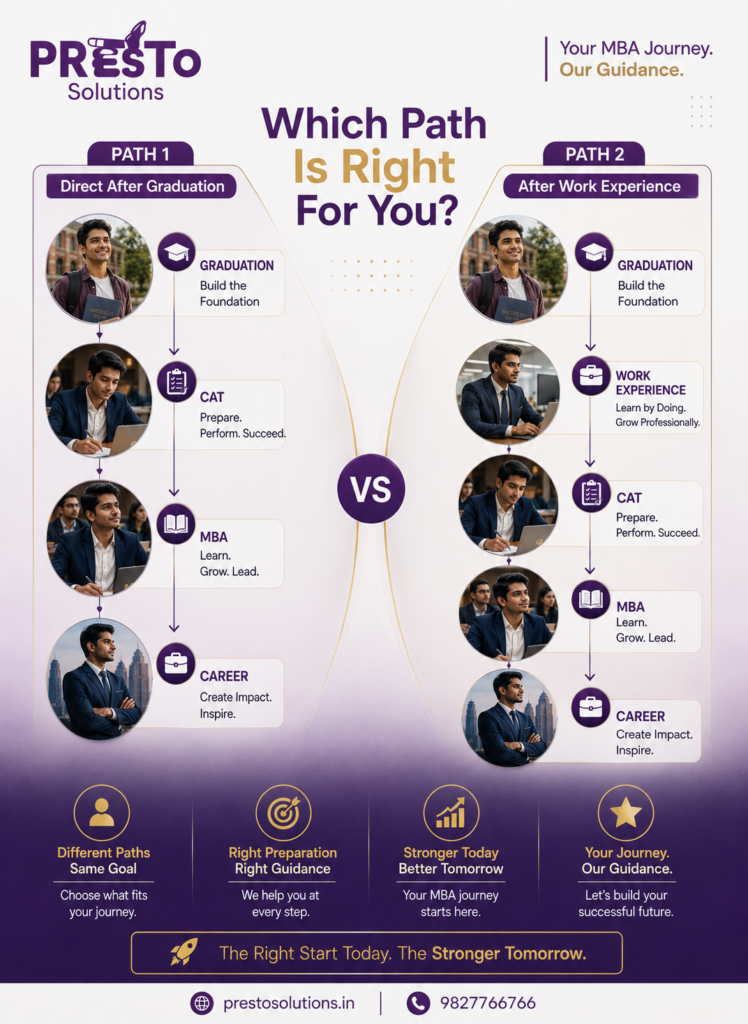
MBA After Graduation vs Work Experience: The Real Decision Framework
Instead of asking:
“Which option is better?”
Ask yourself these five questions.
1. What Is My Career Goal?
If you already know your desired career path, an immediate MBA may make sense.
If you are uncertain, work experience may help you gain clarity.
2. What Is the Quality of My Current Job Opportunity?
A strong role with learning opportunities, responsibility and career progression can be worth pursuing.
But if your job offers little learning or growth, delaying your MBA simply to accumulate “work experience” may not add much value.
3. What Are My Target B-Schools?
This is extremely important.
Make a list of your target colleges and study their latest admission criteria.
Don’t make your decision based on generic internet advice.
4. What Is the Financial Impact?
Calculate:
MBA fees + living expenses + lost salary + other responsibilities
Then compare this with your expected career benefits.
5. What Will Make My Profile Stronger?
Ask yourself:
Will another two years of work meaningfully improve my profile?
If yes, working may be worthwhile.
If you already have a strong academic profile, clear career goals and access to a good MBA opportunity, waiting may not necessarily provide additional value.
The Bottom Line
There is no universal answer to the question:
“Should I do an MBA after graduation or after work experience?”
Both paths can lead to excellent management careers.
A fresher can bring academic freshness, adaptability and early-career energy to an MBA programme.
A working professional can bring practical exposure, professional maturity and greater clarity.
The key is to choose the route that aligns with your career goals, financial situation, target B-schools and personal circumstances.
Most importantly, don’t pursue work experience merely because someone told you that “MBA colleges prefer experienced candidates.”
And don’t pursue an MBA immediately simply because you want to avoid entering the workforce.
Make the decision strategically—not emotionally.
Need Help Deciding Your MBA Path?
If you’re confused about whether to pursue CAT preparation immediately after graduation or work first, a structured discussion with an experienced mentor can help you evaluate your academic profile, career goals and target B-schools.
At Presto Solutions, we help MBA aspirants prepare for management entrance exams such as CAT, CMAT and other major MBA entrance examinations through structured preparation, mock tests, mentorship and GD-PI support.
Explore the Presto Solutions CAT preparation programme to learn more.
You can also learn more about Presto Solutions and its approach to management entrance preparation.
Your MBA journey doesn’t have to follow someone else’s timeline.
Choose the path that makes sense for your career.
Frequently Asked Questions
Is it better to do an MBA immediately after graduation?
Not necessarily. An immediate MBA can be a good choice if you have career clarity, financial support and access to a good programme. Working first can be better if you need industry exposure or greater clarity about your career goals.
Do I need work experience to get into an IIM?
No. Work experience is not universally mandatory for two-year MBA programmes at IIMs. Admission criteria vary by institute and programme. IIM Ahmedabad’s PGP, for example, includes both fresh graduates and candidates with work experience.
Does work experience increase my chances of getting an IIM call?
It can contribute positively at institutes that award weightage for work experience, but it is not the only factor. CAT performance, academics, diversity, interview performance and other components can also influence selection. IIM Ahmedabad’s current criteria are an example of this multi-factor approach.
How many years of work experience is ideal before an MBA?
There is no universal ideal number. The right time depends on your target B-schools, career goals, quality of work experience and personal circumstances.
Is an MBA after work experience more valuable?
Not automatically. Work experience can improve practical understanding and career clarity, but the value of an MBA ultimately depends on the quality of the programme, your career goals, skills, network and how you use the degree.
Can freshers get good MBA placements?
Yes. Fresh graduates are admitted to and placed through two-year MBA programmes. However, placement outcomes vary by institute, role, industry, candidate profile and market conditions.