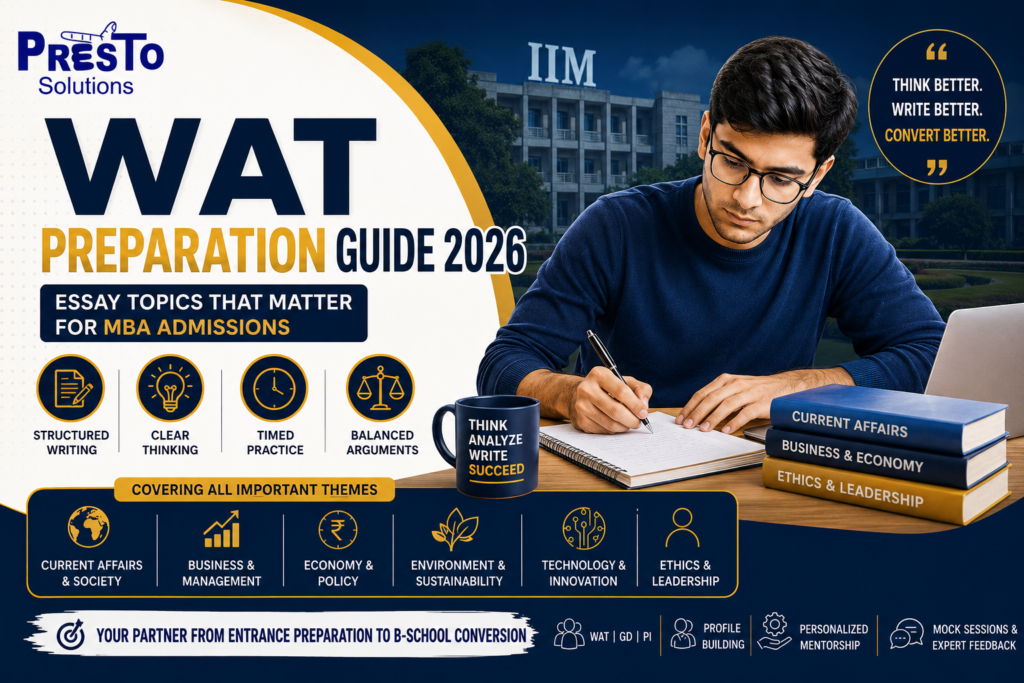
WAT Preparation Guide 2026: Essay Topics That Matter for MBA Admissions
Clearing CAT is a major milestone, but for many MBA aspirants, the journey does not end with the entrance examination. Once you receive calls from leading B-schools, you may have to face additional selection stages such as the Written Ability Test (WAT), Analytical Writing Test (AWT), Personal Interview (PI), or other institute-specific evaluation processes.
For example, IIM Bangalore includes a Written Ability Test as part of its PGP selection process, while IIM Ahmedabad uses an Analytical Writing Test (AWT) along with the Personal Interview for its MBA admissions. The exact format, duration and weightage can vary from institute to institute and from year to year.
That is why WAT preparation should not be treated as an activity you start only after receiving an interview call.
A strong WAT requires much more than good English. You need clarity of thought, awareness of current affairs, logical reasoning, balanced arguments, relevant examples and the ability to communicate your ideas within a limited time.
In this complete WAT Preparation Guide 2026, we will cover the important essay topics you should prepare, how to structure your essay, how to practise effectively, common mistakes to avoid and a practical strategy for improving your WAT performance.

What Is WAT?
The Written Ability Test (WAT) is a written assessment used by several management institutes to evaluate a candidate’s ability to express ideas in a structured and logical manner.
A candidate may be given a topic related to:
- Current affairs
- Business and economics
- Technology
- Social issues
- Ethics
- Education
- Environment
- Geopolitics
- Abstract ideas
- Management
The candidate then has to develop a written response within the time and word-limit requirements specified by the institute.
The objective is not simply to check whether you know about the topic.
The evaluator is interested in understanding how you think and how effectively you communicate that thinking.
IIM Bangalore, for example, states that its WAT is evaluated on the content and style of the written note and currently lists approximately 30 minutes for the exercise.
Similarly, IIM Ahmedabad’s current MBA admission process refers to an Analytical Writing Test (AWT) rather than using the WAT terminology.
What Does WAT Evaluate?
A good WAT response generally demonstrates:
- Clarity of thought
- Logical reasoning
- Written communication
- Awareness of important issues
- Ability to analyse multiple perspectives
- Relevant examples
- Coherent structure
- Grammar and readability
- Ability to reach a reasoned conclusion
In simple words:
WAT tests whether you can think clearly and communicate effectively under pressure.
Why Is WAT Important for MBA Admissions?
MBA programmes are designed to develop future managers, entrepreneurs and business leaders.
These professionals are expected to analyse problems, evaluate alternatives, communicate recommendations and make decisions.
WAT is one way institutes can assess a candidate’s ability to perform some of these skills in a written format.
The importance of the written component can also be seen in actual admission processes. IIM Bangalore currently assigns a weight to WAT in its post-PI selection process, while IIM Ahmedabad includes AWT as part of its selection process.
Therefore, candidates should think beyond:
“How do I score well in CAT?”
and also prepare for:
“How do I convert my B-school call?”
If you are still working on your entrance preparation, you can explore the structured approach followed in Presto Solutions’ CAT preparation program, which also includes GDPI and WAT preparation.
What Makes a Good WAT Essay?
A good WAT essay is not the one that uses the most complicated vocabulary.
It is the one that presents a clear argument in a logical and readable manner.
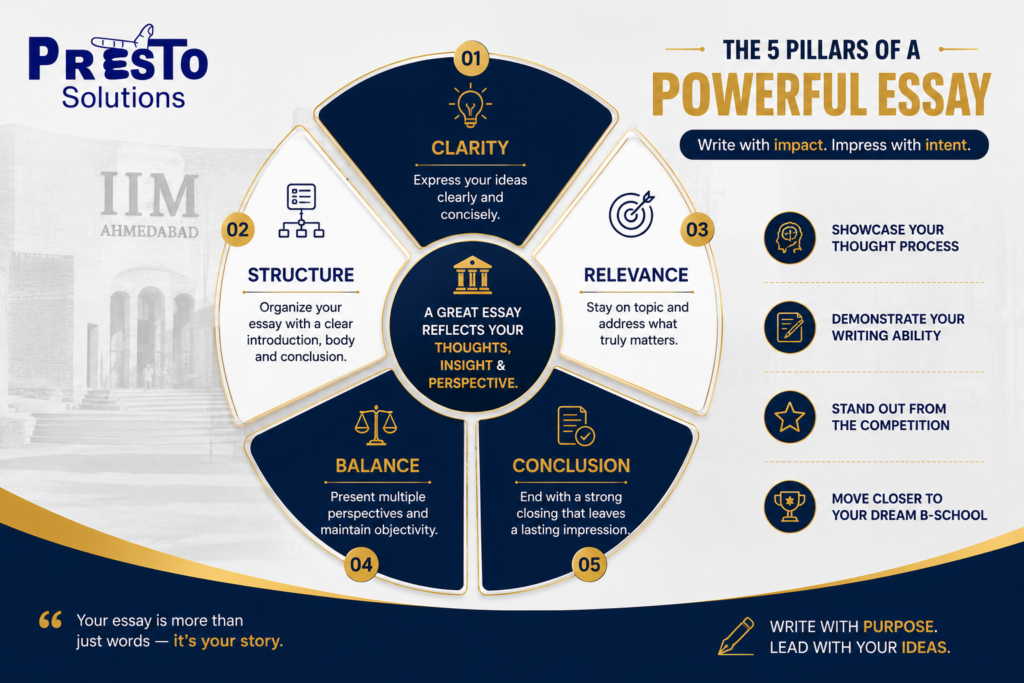
There are five fundamentals every MBA aspirant should remember.
1. Clarity
Your evaluator should understand your argument without having to decode complicated sentences.
2. Structure
Your ideas should follow a logical sequence.
3. Relevance
Every paragraph should contribute to answering the topic.
4. Balance
For controversial topics, acknowledge different perspectives before arriving at your position.
5. Conclusion
Finish with a meaningful, reasoned and forward-looking conclusion.
How to Structure a WAT Essay
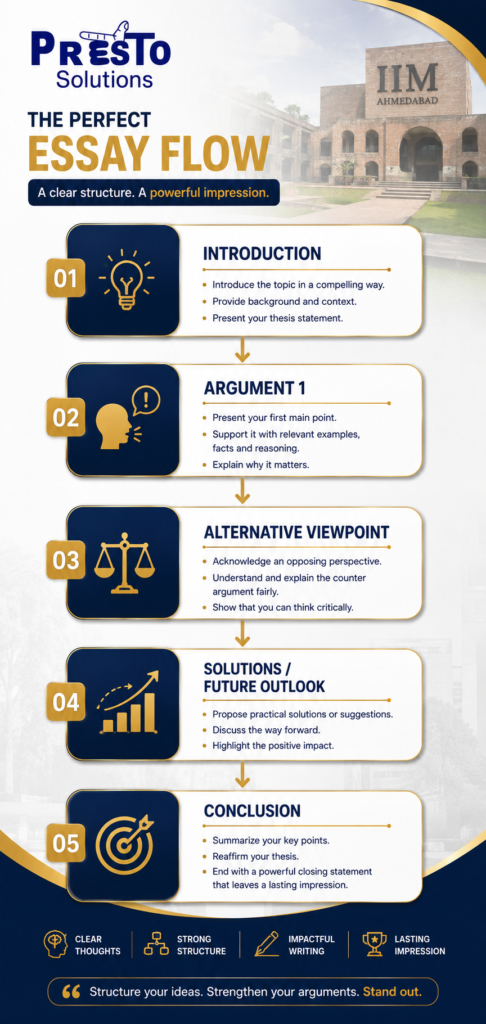
One of the biggest advantages you can have during WAT is a ready-to-use writing structure.
Instead of spending five minutes wondering how to begin, use a simple framework.
1. Introduction
Start by establishing the context.
You can:
- Define the central idea
- Explain the background
- Introduce the issue
- Present a relevant example
- Explain why the topic matters
Keep your introduction concise.
The purpose is to tell the evaluator:
What is the issue and how am I going to approach it?
2. Body Paragraph 1 — Primary Argument
Present your first major argument.
Support it with relevant:
- Examples
- Facts
- Business cases
- Historical events
- Current developments
- Social implications
Avoid making unsupported statements.
3. Body Paragraph 2 — Alternative Perspective
This is where many candidates can differentiate themselves.
Instead of presenting only one side, ask:
What is the strongest argument against my position?
For example, if the topic is:
“Artificial Intelligence will eliminate jobs.”
A weak essay might simply argue that AI will replace human workers.
A better essay could discuss:
- Automation of repetitive tasks
- Creation of new technology-driven roles
- Productivity improvements
- Reskilling requirements
- Unequal impact across industries
- The importance of education and workforce transition
This demonstrates balanced and mature thinking.
4. Body Paragraph 3 — Solutions or Future Outlook
Depending on the topic, this paragraph can discuss:
- Practical solutions
- Policy interventions
- Business implications
- Social consequences
- Future trends
- The way forward
5. Conclusion
Your conclusion should bring your argument together.
A good conclusion can:
- Summarise your central argument
- Acknowledge the complexity of the issue
- Present a balanced position
- Suggest a practical way forward
Do not introduce a completely new argument in the final paragraph.
High-Priority WAT Topics for MBA Aspirants
You cannot predict the exact topic that will appear in a WAT.
However, preparing broad themes can help you handle unfamiliar topics with confidence.
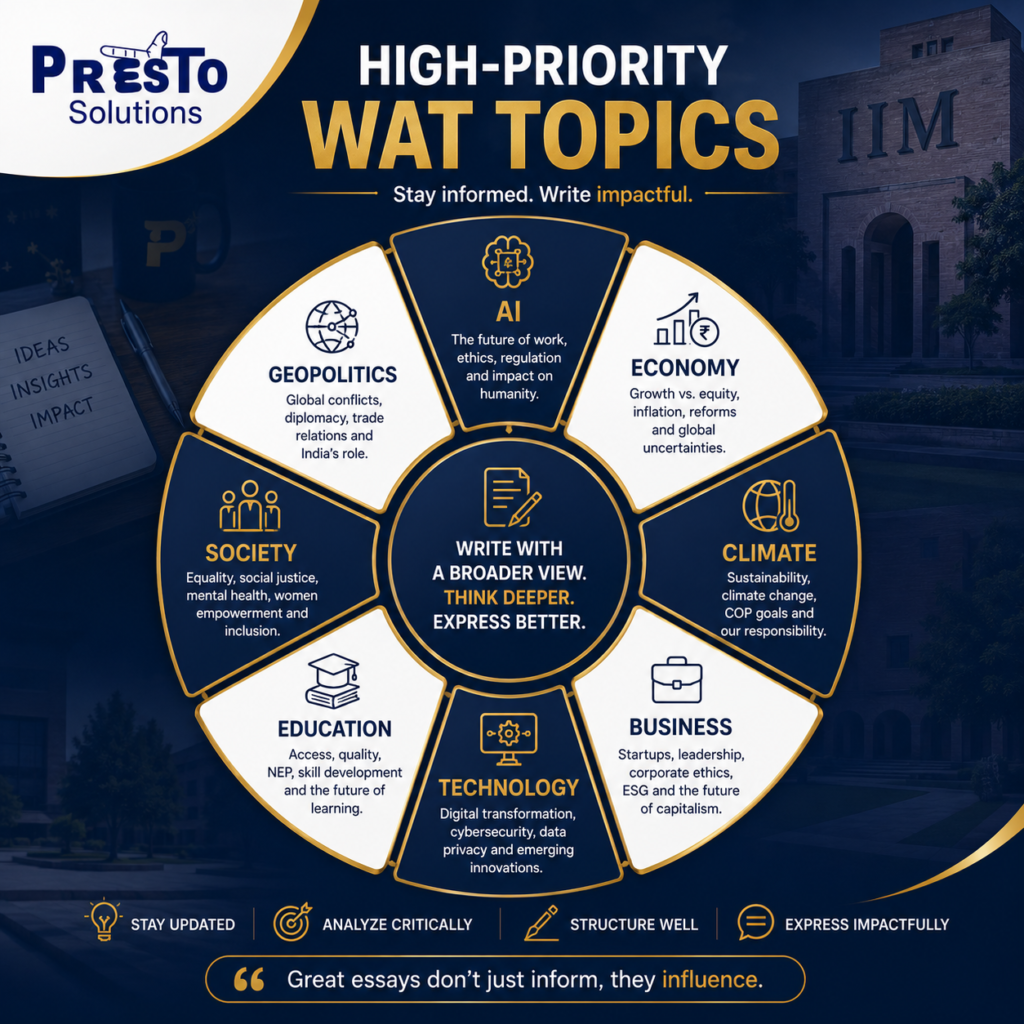
Here are some high-priority WAT essay topics worth preparing.
1. Artificial Intelligence and the Future of Work
Prepare arguments around:
- Automation
- Job displacement
- New employment opportunities
- AI productivity
- Reskilling
- Human-AI collaboration
- AI regulation
2. Climate Change and Sustainable Development
Important areas include:
- Renewable energy
- Sustainable businesses
- Carbon emissions
- ESG
- Climate finance
- Green technology
- Corporate responsibility
3. India’s Economic Growth
Prepare themes such as:
- GDP growth
- Employment
- Manufacturing
- Infrastructure
- Digital economy
- Startups
- Rural development
- Inclusive growth
4. Digital Privacy and Data Protection
Possible discussion points include:
- Personal data
- User consent
- Cybersecurity
- Data ownership
- Government regulation
- Technology companies
- AI and privacy
5. Social Media and Society
Think about both advantages and challenges:
- Access to information
- Digital activism
- Misinformation
- Privacy
- Mental well-being
- Influencer culture
- Political communication
6. Entrepreneurship and Innovation
Prepare topics around:
- Startup ecosystems
- Innovation
- Venture capital
- Risk-taking
- Employment generation
- Disruptive businesses
- Entrepreneurial culture
7. Leadership and Ethics
Potential questions include:
- Can an effective leader compromise on ethics?
- Is ethical leadership compatible with profitability?
- How should leaders handle crises?
- Should businesses prioritise shareholders or wider stakeholders?
8. Gender Equality and Inclusion
Prepare arguments around:
- Women’s workforce participation
- Equal pay
- Leadership representation
- Workplace inclusion
- Education
- Social barriers
9. Globalization vs Protectionism
Understand both sides of the debate.
Prepare examples involving:
- International trade
- Domestic manufacturing
- Supply chains
- Employment
- Tariffs
- Economic sovereignty
10. Education Reforms
Important areas include:
- Education accessibility
- Skill development
- Employability
- Digital learning
- Higher education
- Education technology
- National Education Policy
Abstract Essay Topics You Should Practise
Abstract topics can initially appear difficult because they do not have a single obvious interpretation.
But that is exactly what makes them useful for WAT preparation.
Practise topics such as:
- Success is a journey, not a destination.
- Change is the only constant.
- Actions speak louder than words.
- Failure is the foundation of success.
- The power of silence.
- Technology is a good servant but a bad master.
- Every cloud has a silver lining.
- Knowledge without wisdom is incomplete.
How to Approach Abstract Topics
Do not restrict an abstract topic to one interpretation.
For example:
“Change is the only constant.”
You could discuss change through:
- Technology
- Business
- Personal development
- Economics
- Leadership
- Society
The objective is to demonstrate depth of thought and logical interpretation, not philosophical vocabulary.
Business and Management WAT Topics
Management aspirants should give special attention to business-related issues.
Practise topics such as:
- ESG and sustainable management
- Digital transformation
- Future of remote work
- Leadership during crisis
- Innovation and management
- Startup funding
- Corporate governance
- Ethical decision-making
- Corporate social responsibility
- Future of entrepreneurship
- Technology-driven businesses
- Workplace transformation
For each topic, prepare both the business perspective and the wider social impact.
Ethical and Social Issues for WAT
Ethical topics are particularly useful for developing balanced arguments.
Prepare:
- AI ethics
- Freedom of speech
- Inclusive growth
- Diversity in the workplace
- Environmental responsibility
- Mental health awareness
- Work-life balance
- Responsible use of technology
- Privacy versus security
- Corporate responsibility
A Simple Rule for Ethical Topics
Avoid extreme statements.
Instead of writing:
“Technology is harmful to society.”
ask:
“Under what circumstances can technology become harmful, and how can those risks be managed?”
This shift from an absolute position to a nuanced argument can make your essay considerably stronger.
WAT Preparation Strategy: How to Prepare Effectively
WAT preparation does not mean memorising 100 essays.
Instead, build a system that develops three skills:
Awareness + Analysis + Articulation
Here is a practical strategy.
1. Write One Essay Every Day
Start with 3–4 essays per week if you are new to WAT preparation.
As you become more comfortable, move towards regular daily practice.
Begin with approximately 250–300 words unless your target institute specifies a different requirement.
The objective is to develop:
- Writing speed
- Logical structure
- Idea generation
- Vocabulary
- Confidence
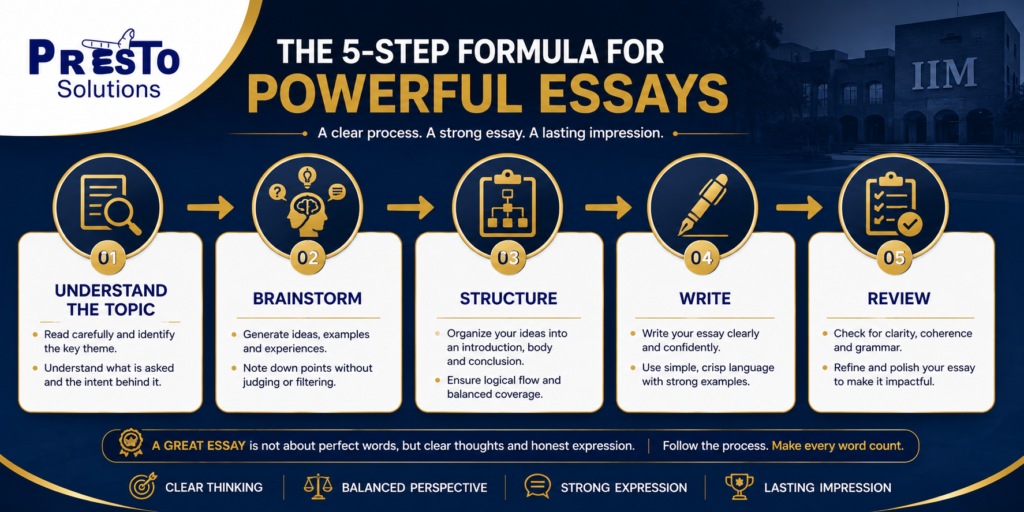
2. Practise Under a Timer
Writing an essay without a time limit is very different from writing one during an actual WAT.
A practical practice structure can be:
2–3 minutes: Understand the topic
2–3 minutes: Brainstorm arguments
10–15 minutes: Write
2–3 minutes: Proofread
Adjust this according to the time and instructions of the institute you are targeting.
3. Read Editorials Every Day
Regular reading is one of the best ways to improve your WAT preparation.
Read editorials and analysis from reputed newspapers and publications.
But don’t read passively.
After reading an article, ask:
- What is the central issue?
- What is the author’s argument?
- What is the counterargument?
- What evidence supports the argument?
- What are the implications?
- What would be a practical solution?
This turns reading into WAT preparation.
4. Build a Repository of Examples
Create a notebook or digital document with categories such as:
- Economy
- Business
- Technology
- Environment
- Education
- Healthcare
- Government
- International relations
- Startups
- Society
You don’t need hundreds of statistics.
A small collection of accurate, relevant and memorable examples is much more useful.
5. Learn to Look at Both Sides
Whenever you study an issue, use this three-step method:
FOR
What are the strongest arguments supporting it?
AGAINST
What are the strongest arguments opposing it?
BALANCED VIEW
What would be a reasonable position after considering both sides?
This habit can significantly improve your WAT responses.
6. Get Your Essays Evaluated
Self-evaluation is useful, but external feedback can identify mistakes you may not notice yourself.
Ask a mentor, teacher or peer to evaluate:
- Structure
- Grammar
- Relevance
- Logical flow
- Arguments
- Examples
- Conclusion
- Time management
Keep a record of recurring mistakes.
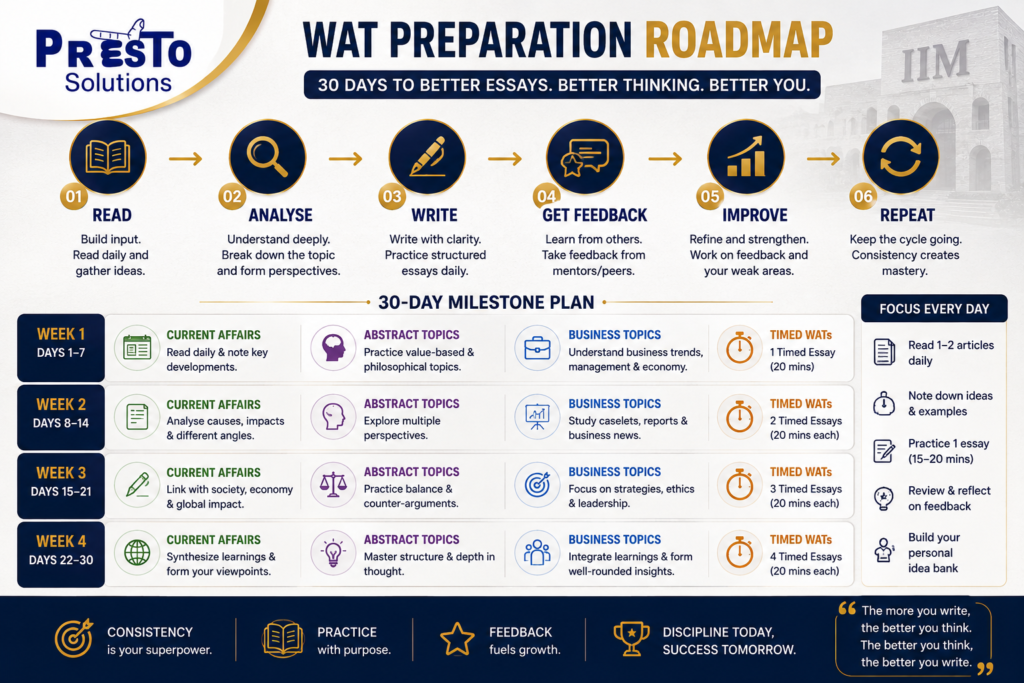
The PRESTO WAT Framework
At Presto Solutions, one of the most useful ways to approach a written topic is to break the thinking process into simple steps.
Use the PRESTO Framework:
P — Perspective
Understand exactly what the topic is asking.
R — Reasons
Identify the major arguments and reasons.
E — Examples
Think of relevant facts, examples or real-world situations.
S — Sides
Consider multiple perspectives.
T — Take a Stand
Develop a reasoned position.
O — Outcome
End with a practical and forward-looking conclusion.
This framework can help you move from a blank page to a structured essay much faster.
A Sample WAT Thought Process
Consider the topic:
“Artificial Intelligence will create more jobs than it destroys.”
Before writing, quickly create an outline.
Introduction:
AI is transforming the nature of work across industries.
Argument 1:
Automation may replace repetitive and predictable tasks.
Argument 2:
AI can create new roles in areas such as data, cybersecurity, AI development and AI-enabled business functions.
Counterargument:
The transition may disproportionately affect workers who do not have access to relevant skills.
Way Forward:
Reskilling, education and responsible adoption will influence the employment impact of AI.
Conclusion:
The impact of AI on employment will depend not only on the technology itself, but also on how effectively individuals, businesses and governments adapt to it.
Notice that you do not need to know the entire future of AI.
You need to identify the issue, consider both sides and build a logical argument.
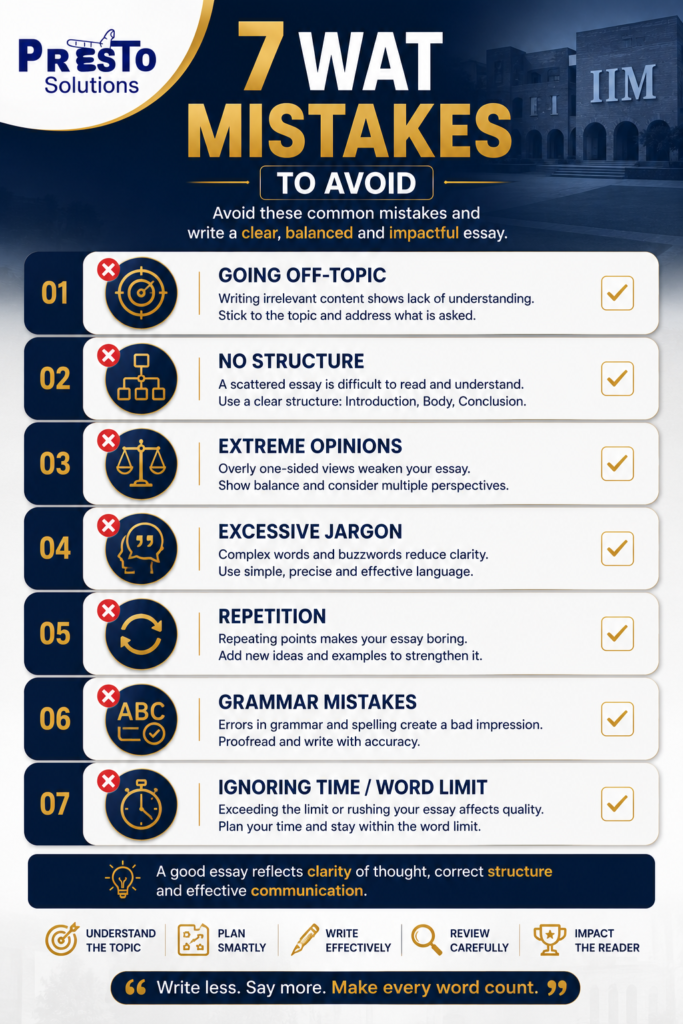
Common WAT Mistakes You Must Avoid
Even candidates with excellent knowledge can lose marks because of poor execution.
1. Going Off-Topic
Do not write everything you know about a related subject.
Stay focused on the exact question.
2. Writing Without Structure
A collection of disconnected thoughts is not a well-written essay.
Every paragraph should have a clear purpose.
3. Taking Extreme Positions
Avoid absolute statements unless you can strongly justify them.
Real-world issues usually involve competing interests and trade-offs.
4. Using Excessive Jargon
WAT is not a vocabulary competition.
Clarity is more important than complexity.
5. Repeating the Same Argument
Do not repeat an idea merely to increase the word count.
Each paragraph should add something new.
6. Ignoring Grammar and Punctuation
Always leave time for proofreading.
Check:
- Spelling
- Grammar
- Sentence construction
- Punctuation
- Subject-verb agreement
- Repeated words
7. Exceeding the Time or Word Limit
A strong argument written after the deadline is still a problem.
Practise under realistic conditions.
How Many Essays Should You Write Before WAT?
There is no magic number.
Quality of practice matters more than the number of essays.
A practical preparation progression can look like this:
Beginner Stage
Write 3–4 essays per week.
Focus on structure and idea generation.
Intermediate Stage
Write 5–6 essays per week under timed conditions.
Focus on speed, arguments and examples.
Final Stage
Conduct regular full WAT simulations.
Practise topics from:
- Current affairs
- Business
- Economy
- Ethics
- Society
- Technology
- Abstract themes
- International relations
After every essay, identify what you could improve.
Writing 50 essays without reviewing them is far less useful than writing 25 essays and learning from each one.
Practice Resources for WAT Preparation
You do not need dozens of resources.
Focus on a few reliable sources and use them consistently.
Recommended resources:
- Editorials from reputed newspapers
- Business and policy publications
- Government reports
- Previous MBA WAT topics
- Current affairs compilations
- Business magazines
- Timed WAT mocks
- Faculty feedback
- Peer review
For candidates preparing for multiple management entrance exams, developing strong reading and writing habits can also support preparation for exams such as CAT, XAT and CMAT.
You can explore Presto Solutions’ CAT preparation program and CMAT preparation program for structured entrance preparation.
WAT Preparation Checklist
Before your WAT round, make sure you can:
- ☑ Understand an unfamiliar topic quickly
- ☑ Generate multiple arguments
- ☑ Identify opposing viewpoints
- ☑ Create an outline within a few minutes
- ☑ Write clear and concise sentences
- ☑ Use relevant examples
- ☑ Maintain logical flow
- ☑ Avoid unnecessary jargon
- ☑ Proofread quickly
- ☑ Finish within the prescribed time
- ☑ Stay within the specified word limit
Most importantly, remember:
WAT is not about writing the “perfect” essay.
It is about demonstrating that you can think, analyse and communicate effectively under pressure.
Frequently Asked Questions About WAT Preparation
Is WAT difficult for CAT aspirants?
WAT can be challenging because candidates need to think, structure and write within a limited time. However, regular practice can significantly improve speed, clarity and confidence.
How long should a WAT essay be?
There is no single universal word limit. Requirements vary by institute and programme. Follow the specific instructions given by the institute for your selection process.
During preparation, practising essays of around 250–300 words is a useful starting point.
Should I memorise essays for WAT?
No.
Memorising complete essays can make your writing mechanical and may not help when you receive an unfamiliar topic.
Instead, prepare:
- Arguments
- Examples
- Facts
- Current affairs
- Frameworks
- Topic-wise notes
Should I use difficult English vocabulary?
No.
Simple, precise and grammatically correct English is generally more effective than unnecessarily complicated vocabulary.
Your evaluator should understand your argument easily.
How can I improve my WAT writing?
Follow a simple cycle:
Read → Think → Write → Review → Improve
Read editorials, write regularly, practise under time constraints and get your essays evaluated.
When should I start WAT preparation?
Do not wait until you receive an interview call.
Building reading, analytical thinking and writing habits during your CAT preparation gives you more time to improve.
Does every IIM conduct WAT?
No single format applies to every IIM or every admission cycle.
Institutes may use WAT, AWT, PI or other components, and the process can change from year to year. Always check the official admission criteria of the institute you are targeting. For example, IIM Bangalore currently specifies WAT in its PGP process, while IIM Ahmedabad uses AWT.

Final Thoughts
WAT preparation is not something you can master overnight.
The strongest candidates develop three habits:
Read widely. Think critically. Write clearly.
Stay updated with business, economics, technology, governance, social issues and international affairs.
But don’t stop at reading.
Train yourself to ask:
- What happened?
- Why did it happen?
- What are the different perspectives?
- What are the implications?
- What could be the solution?
Then practise converting those thoughts into a structured essay.
Remember the formula:
Understand → Analyse → Structure → Write → Review
With consistent practice, even an unfamiliar WAT topic becomes manageable.
And remember — your CAT percentile may get you the call, but your performance in the selection process helps you convert it.
If you are preparing for CAT and targeting IIMs and other top B-schools, explore Presto Solutions’ CAT coaching program, which includes structured preparation along with GDPI and WAT support.
Prepare Early. Think Better. Write Better. Convert Better.
Presto Solutions — Your Partner from Entrance Preparation to B-School Conversion.
Contact Presto Solutions to learn more about preparation programs in Indore, Bhopal and online.
Internal Links Used
- CAT preparation → Presto CAT Coaching page
https://prestosolutions.in/best-cat-coaching-in-indore-bhopal/ - CMAT preparation → Presto CMAT Coaching page
https://prestosolutions.in/cmat-coaching-in-indore-and-bhopal/ - Contact Presto Solutions → Contact page
https://prestosolutions.in/contact/ - GDPI preparation → Presto CAT page / existing GDPI article
https://prestosolutions.in/2026/06/06/gdpi-preparation-tips-how-to-convert-iim-calls-easily/
External Links:
- IIM Bangalore PGP Admission Process — official WAT details IIM Bangalore PGP Admission Process
- IIM Ahmedabad MBA Admissions — official AWT/PI information IIM Ahmedabad MBA Admissions
- IIM Ahmedabad 2026–28 Selection Criteria — official current admission details IIM Ahmedabad MBA Selection Process